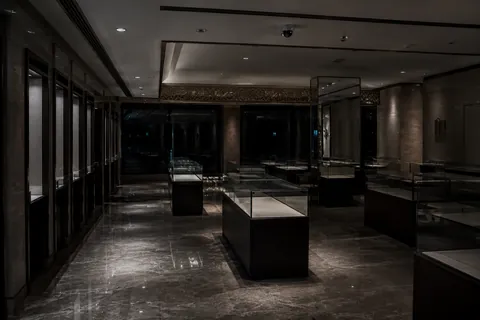
Sector
Jewellery
Armed robbery happens, but it is not where most jewellery losses come from. They happen at the handover, in the workshop, and at stock-take, and they are discovered weeks later, when the footage has already been overwritten. We design and maintain systems for showrooms, bourse units and workshops in Mumbai, specified against what your insurance policy actually requires.
Most losses in a jewellery business are not armed robbery. They happen at the handover, in the workshop and at stock-take, and they are discovered weeks later when the footage has already been overwritten. We design and maintain systems for showrooms, bourse units and workshops in Mumbai, specified against what your insurance policy actually requires.
What actually goes wrong
The robbery is what you insure against. The shrinkage is what you live with.
| What fails | Why it fails | What it costs |
|---|---|---|
| The recorder sits beside the safe | One cupboard, one room. | Whoever reaches the stock reaches the evidence of reaching it. |
| Retention shorter than your stock cycle | Set from the recorder's default, not from how often you count stock. | A discrepancy found at stock-take is weeks old. The footage covering it was overwritten before anyone went looking. |
| The counter is covered, the handover is not | Cameras aimed where customers stand, not where stock moves between hands. | Excellent footage of the transaction and none of the moment that matters. |
| The workshop is uncovered on principle | Karigars are trusted, so the area with the most unsupervised stock has the least coverage. | The one place you would need to look is the one place you cannot. |
| Panic buttons wired to nothing | Installed, never tested, often not connected to any receiving station. | Everybody believes there is a response. There is a button. |
| Nobody checks the system against the policy | Conditions agreed at signing, never verified since. | You discover the gap at the only moment it is expensive to discover it. |
The question nobody asks until a claim
Your policy lists conditions. When did anybody last check the system meets them?
A Jewellers Block policy does not simply cover stock. It sets out conditions: what must be installed, what must be recording, what must be locked and when. Those conditions were true on the day the policy was written. Equipment has failed since. Retention has quietly shortened. A camera was moved during a renovation.
Claims are not usually refused because there was no system. They are refused, or reduced, because the system did not meet the terms on the day it mattered.
Check my system against my policyWhat we carry here
- Surveillance
- Counter, handover point, strongroom approach, workshop
- Retention set from your stock-take cycle
- Recorder sited away from the stock it protects
- Intrusion & hold-up
- Safe and strongroom protection
- After-hours detection
- Panic devices connected, tested and logged
- Access control
- Showroom, office, workshop, strongroom as separate zones
- Dual control on the strongroom where the policy requires it
- Every entry recorded and reportable
- Fire & life safety
- Stock cannot be evacuated during an alarm
- The strongroom cannot be opened during one either
- Detection specified for that, not for an office
Building management and AV are not part of a standard jewellery specification. We list that so you know we are not selling you something you do not need.
The same six stages
A showroom is not a compound. The stages still apply: they just compress.
- 01 Outside the gate A public street, not a compound. The useful window is seconds. Coverage of the pavement and the vehicle drop matters more than any perimeter.
- 02 Entry The shop door or the bourse unit door. Interlocked entry where the risk justifies it, and a controlled route for deliveries.
- 03 Inside the building Counter to back office to workshop to strongroom. Stock movement is the route that has to be followable, not people.
- 04 Who goes where Staff zoning by role. Who may be in the strongroom, with whom, and at what hours. Recorded rather than assumed.
- 05 Work areas Detection, hold-up devices, safe protection, and a fire strategy that accounts for stock that cannot be moved.
- 06 Control room Usually a recorder in a cupboard. Retention, health monitoring and evidence export are the whole of it, and all three are usually wrong.
Proof
Three premises, three problems.
We do not publish our clients' names in this sector, and we will not publish yours. Discretion is not modesty. In this trade it is part of the service.
Year seven
Nobody in a jewellery shop is paid to notice that a camera has stopped working.
An office has a facility manager whose job includes looking. A showroom has an owner, a manager and staff, and all three are with customers. The system is assumed to be working because the lights on the front are on, and those lights stay on long after the recording has stopped.
The usual one is a recorder writing to a failing drive. Live view works. The screen says healthy. Ninety days of retention has quietly become eleven. Nobody finds this by watching. It is found the morning somebody asks for footage from six weeks ago.
The second is the refit. Showrooms are redone every few years, and every refit moves a camera, blocks a detector or cuts a cable. What was specified is no longer what is installed, and the policy conditions were signed against the specification.
Find out what your system is actually doing.
We test every camera, recorder, panic device and lock on your premises, check it against your policy conditions, and give you a signed condition report. It is yours whatever you decide to do next.
The assessment is chargeable, quoted against the site, and adjusted in full against the first year if you take cover. Where cover is not taken, the fee covers our team’s time on site and the report we leave behind, and the report is yours either way.
Chargeable, and adjusted in full if you take cover.
Book an assessment