AMC
System health check
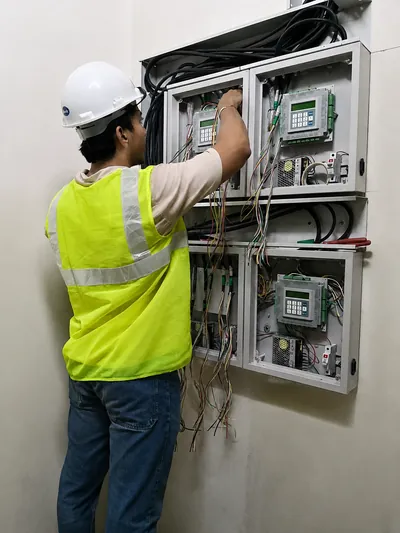
One working day on your site, testing every device you have rather than reading a status screen. You get a signed condition report that tells you what is actually running, what is not, and what it would take to fix.
Why it is paid
A free survey is a sales visit with a clipboard.
It takes an hour, it looks at what is convenient, and it produces a quotation rather than a finding, because the person doing it is paid only if you buy something.
Charging changes what the day is. We can spend it testing rather than selling, we can tell you the system is in reasonable condition without having wasted our time, and you can take the report to somebody else without owing us anything. The fee is credited in full against your first year if you take cover with us, so it costs nothing in the case where we were right about your system.
What happens on the day
- We walk the site in the six stages we design inOutside the gate, entry, inside the building, who goes where, work areas, and the control room. It takes longer than a survey because we are following routes rather than visiting equipment.
- Every accessible device is tested individuallyNot sampled. Cameras checked for usable image at the worst light on your site, readers tested, detectors verified, panels interrogated.
- Retention is measured, not readWe check what is actually on the disk against what the system claims and what your specification required. This is the finding that surprises people most often.
- Interlocks are exercised where it is safeDoor release, lift recall, damper closure. Anything that cannot be exercised without a shutdown is recorded as unverified rather than assumed to work.
- Photographs are taken as we goUnedited, and used as the evidence in the report. Six to nine of them make the numbers believable to somebody who was not there.
- The report is with you the next morningSigned, countersigned, and prioritised into critical, important and when convenient.
What we find
Every system reports healthy. That is what makes this expensive.
These are from assessments we have actually run. None of these sites had reported a fault, and none of them knew.
- 41 of 60
- Cameras dead or degradedA Lower Parel high-rise, before the first maintenance visit. Nothing had been reported.
- 12 days
- Retention on a system sold as 90A failing drive had been overwriting for months while the recorder reported healthy.
- 0 of 6
- Hold-up devices connectedSix panic buttons installed, tested at handover, connected to no receiving station.
What you get
What this is not
- It is not a quotation. The report contains no prices. If you want the work done, that is a separate conversation you are free not to have.
- It is not conditional on you buying anything. The report is yours. Take it to your existing contractor, take it to a competitor, use it to renegotiate. We would rather you had an accurate picture than an obligation.
- It is not a survey. A survey looks at what is convenient in an hour. This is a day, every device, with the results written down and signed.
What it costs
The fee is quoted against the site, a house and a factory cannot carry the same fee. It is adjusted in full against the first year if maintenance cover is taken. Where cover is not taken, the fee covers our team’s time on site and the report we leave behind. Credited in full against the first year if you take a maintenance contract with us within ninety days.
Common questions
The next rung
Cover follows the report, never the other way round.
Once you know what you have, comprehensive cover is a decision rather than a guess.
What this looked like on a real site
Find out what is actually running on your site.
One day, every device, a signed report the next morning. Yours to keep whatever you decide afterwards.
The assessment is chargeable, quoted against the site, and adjusted in full against the first year if you take cover. Where cover is not taken, the fee covers our team’s time on site and the report we leave behind, and the report is yours either way.
Chargeable, and adjusted in full if you take cover.
Book an assessment