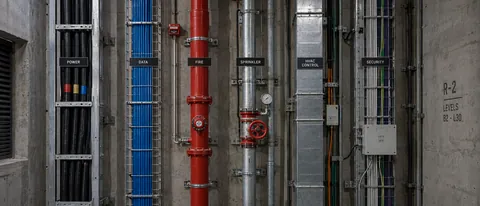
Six systems, one contract
The interfaces between these are the whole point.
Most facilities are secured by a collection of separately procured products that were never asked to work together. Each one passes its own test. The gaps between them belong to nobody, and the gaps are where every serious failure lives.
- 01 Surveillance A camera that is recording and a camera that is producing usable evidence are two different things, and most of the systems we assess are the first. The difference is decided at design. In how the camera is specified against the worst light on that site rather than the datasheet, and in whether retention was calculated or assumed.
- 02 Fire & life safety Fire is the only system in a building that is examined by an authority before occupation and by an inquiry afterwards. Almost every installation we assess works as a fire alarm and fails as a fire response, because the alarm was contracted and the response was assumed.
- 03 Access control Access control is a people process with hardware attached, and almost none of the failures we find are reader failures. They are credentials belonging to people who left, doors that no longer sit properly in their frames, and controls switched off because they created a queue at shift change.
- 04 Intrusion & hold-up An intrusion system is judged on how often it raises a false alarm and whether anybody responds when it raises a real one. Both are design decisions rather than product decisions, and a system that fails the first test is always switched off before it gets a chance to fail the second.
- 05 Building management This is the system that turns a set of alarms into a building response. Dampers close, lifts recall, pressurisation starts, lighting comes on. Or none of it does, and the building behaves exactly as it would have with nothing installed. In almost every case the equipment was fine and the interfaces were never built.
- 06 Command & integration Every other discipline produces events. This is the one that decides whether a person can act on them. It is also the discipline that separates a firm that installs systems from a firm that engineers them, and it is where most integrations quietly stop at the point of demonstration.
and the network they all run on
Networking Most networks were built to connect people. Almost none were built to answer questions about them. That difference does not matter until somebody asks. Then it is the only thing that matters, and it is not something you can add afterwards without taking the network apart.Have a specification reviewed before it goes out.
Findings in writing, no obligation, and no approach to your client.
The assessment is chargeable, quoted against the site, and adjusted in full against the first year if you take cover. Where cover is not taken, the fee covers our team’s time on site and the report we leave behind, and the report is yours either way.